Class 17: Systems Thinking. "AI is never incremental. It is always exponential."

Transformation Partner, Credera (Omnicom)
The class in brief
Katrin placed the same object, a taxi, on three altitudes of design, named four mechanisms for how systems actually change. This pushed the room to chase an idea's effects past the obvious first move.
After this page you can place any brief on the classic-design-to-computational-design ladder. You can also name which of the four systems-thinking levers you are actually pulling. And you can map an idea's effects out to the third order before you trust the story its first order tells you.
Her slides carry a confidentiality footer, so this page teaches her frameworks in the corpus's own words, full credit to her, with a curated set of her slides below.
Never incremental
Why this matters · 6:44 PM
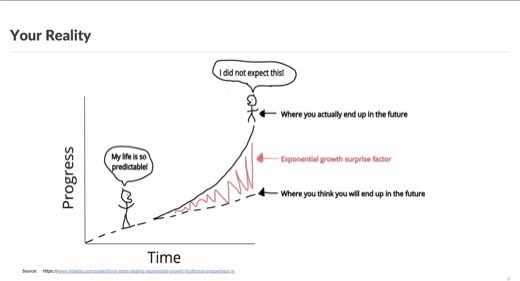
Where you think you will end up is a straight line. Where you actually end up is a curve that breaks upward without warning.
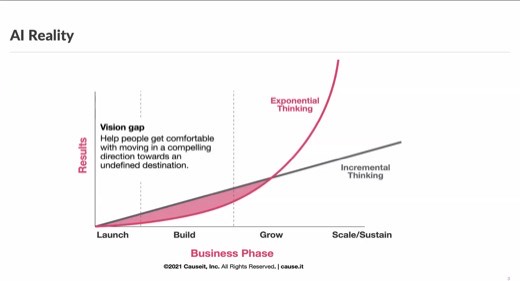
Katrin opened on the gap between predictable, linear progress and the exponential curve AI actually produces. This is the "vision gap," between comfortable incremental thinking and a result that outperforms it once you cross into growth.
Her framing for the moment we're in: "We are probably at the moment where the Model T was rolling off, and we all were able to drive something that yet had to find stoplights and seat belts and all of the things."
In other words, the tools already work and are already useful, but the safety rules and norms around them have not caught up yet.
"We do not have yet the systemic understanding of how AI is going to change how we work, how the organizations work that we work in, how the systems, the government, the structures that we live in will be evolving."
Katrin, on why doom dominates the conversation
The framework · 6:47 PM
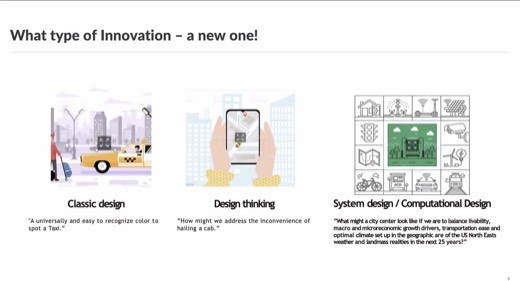
One taxi shown at three levels of innovation
Classic designfeature and quality focus
A taxi is easy to spot from a block away because it is yellow, and classic design stops at the object itself.
Design thinkinghuman needs and experience focus
Not the cab, the inconvenience of hailing one. This is Uber's whole redesign, and it never touches the vehicle.
System design, computational designsystems and data focus
What should a city center look like if you balance livability, economic growth, transportation, and climate all at once, for the next 25 years. More variables than one human brain can hold at the same time, and a different class of design problem entirely.
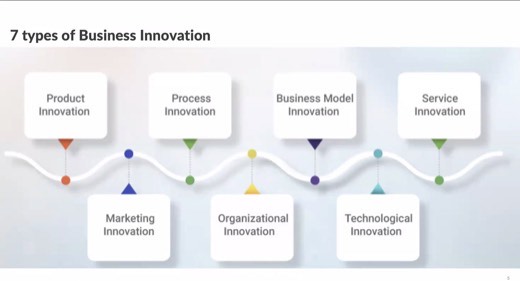
Worked live against a taxi roof sign, the room called the taxi roof sign every type at once, product and marketing, and Katrin agreed it "straddles over different concepts."
Her cleanest example at the top rung was Tesla, not because the car is clever, but because Tesla runs four businesses solving each other's problems at once.
- The EV.
- The charging network.
- A separate profitable battery-lifecycle business.
- The driving data harvested from the fleet toward autonomy.
The craft · 6:57 PM
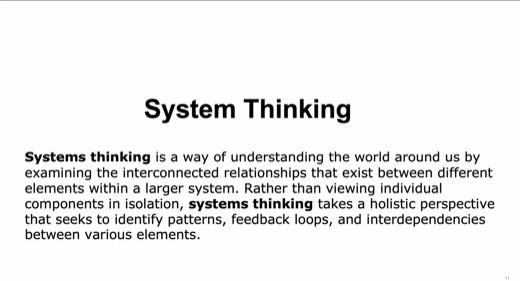
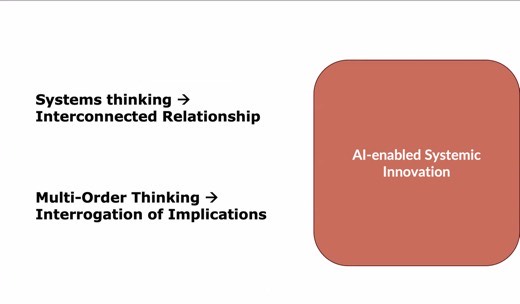
The four levers of systems thinking
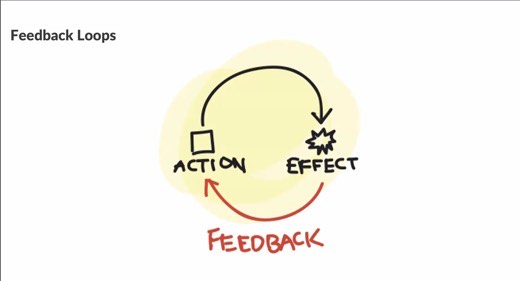
Feedback loopsaction, effect, fed back into the next action
Modern songs run shorter intros than older ones because music is now designed around listening-behavior data. "We are optimizing for listening behavior even in the design of music today," at the cost of creative diversity.
Stocks, flows, and balancing loopswhat comes in and what happens to what goes out
Her example: the EU AI Act, throttling the inflow of what AI is allowed to do to individuals and institutions once a feedback loop's negative side starts winning.
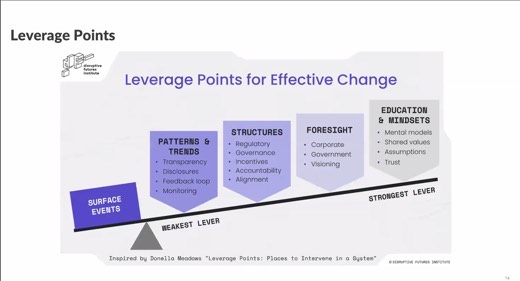
Leverage pointsnot every lever moves the system the same amount
Donella Meadows's ranking of intervention points. The counterintuitive finding: patterns and trends are a weak lever. The strong levers are mindset, culture, and above all trust. Her proof case: Airbnb cut discriminatory outcomes by redesigning the booking flow that shapes trust, not by only reweighting the recommendation algorithm.
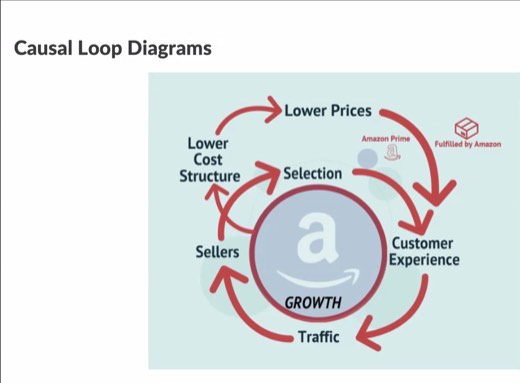
Causal loops, the flywheela virtuous cycle, once it is spinning
Bezos's napkin sketch: lower prices drive traffic, more sellers, a lower cost structure, more selection, lower prices again, with Prime bundled on top. Every student in the room was a Prime member; nobody could name what any single piece of it actually costs.
The exercise · 7:17 PM
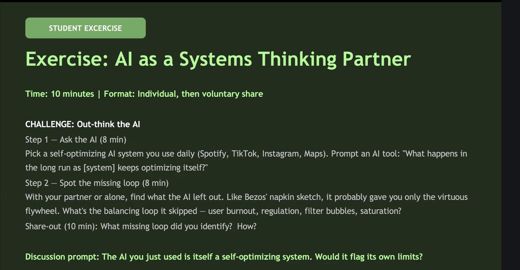
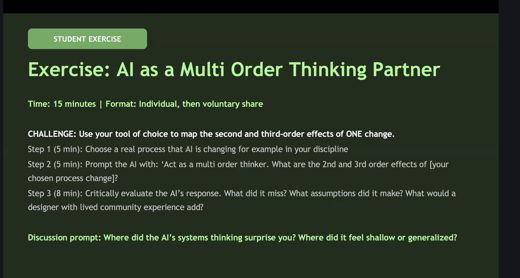
Out-think your own tool
Pick a self-optimizing system you already use daily, then find what the AI's answer left out.
Ask a tool what happens in the long run as your chosen system (Spotify, TikTok, Instagram, Maps) keeps optimizing itself. Then do the harder part alone or with a partner: find the loop the AI's answer left out.
Like Bezos's napkin sketch, the first pass usually gives you only the virtuous flywheel. What is the balancing loop it skipped? Consider these examples.
- Burnout.
- Regulation.
- Filter bubbles.
- Saturation.
The closing question Katrin put to the room: the AI is itself a self-optimizing system. Would it flag its own limits?
One classmate tested it on a major AI lab itself
Asked an AI about Anthropic to check for bias, and got an answer that was "surprisingly not biased at all, very much complimentary." What it never raised on its own: where humans fit in a future of very capable AI.
Katrin's read: "it's not flagging its own limits. It's going on everything can be better and ignoring the reality of the human."
One classmate turned autocorrect into a framework
Ran smartphone autocorrect through the exercise and came back with four evaluation dimensions: accuracy, intent, identity, agency. The systems insight underneath: accepting a wrong autocorrection because you're in a hurry reads to the system as endorsement, so the system reinforces the mistake.
One classmate found the flattering-objective trap
Asked what happens if Spotify keeps optimizing itself, got an answer built around a better listening experience. Re-asked with the real goal stated instead ("maximize profit for Spotify") and got a completely different answer. Models default to the flattering objective unless you name the real one.
The judgment · 7:49 PM
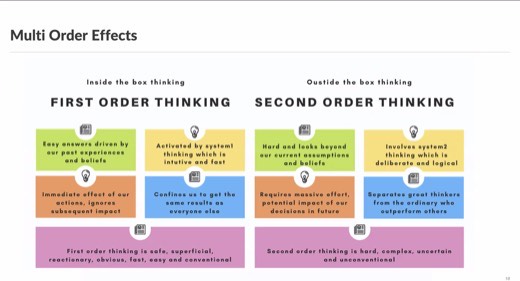
The first-order effect is the obvious one. It is rarely the one that costs the most.
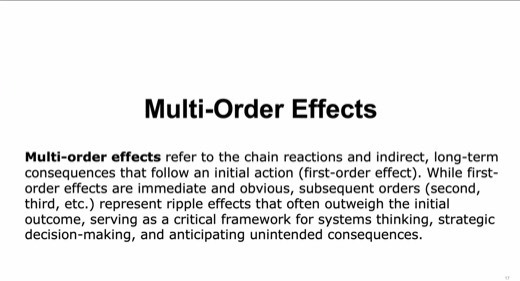
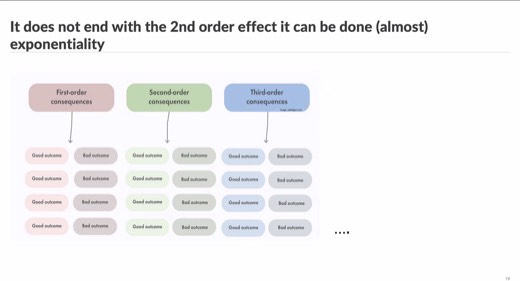
Multi-order effects are the chain reactions that follow an initial change, including second-, third-, and later-order effects that often outweigh the first. Four examples worked live in class.
- The cell phone, built for easier communication, produced isolation as conversation moved to text.
- Airbnb's growth in short-term rentals depleted long-term housing.
- The car connected distant places and widened commutes, while driving climate impact and reshaping cities around parking.
Asked for a positive chain instead, the room mapped GLP-1 drugs as the fourth example.
- A diabetes treatment.
- An accidental weight-loss effect.
- A population-level drop in heart disease.
- A stock downturn for soda and fast food.
- Snack companies reformulating toward a healthier market.
Methods and prompts
Five methods to take with you
Predict the balancing loop before you ask
Guess what a self-optimizing system's own AI-generated growth story leaves out before you check. The gap between your guess and the real answer is the actual lesson.
Working prompt
Before I ask you anything, my prediction for what a self-optimizing system like [system] would leave out of its own growth story: [my answer]. I answer first, then you check me. Now tell me what happens long term as [system] keeps optimizing itself, and tell me if I called the missing loop correctly.
You will know it worked whenit tells you what actually happens long term as the system keeps optimizing, and confirms whether the loop you predicted was missing was the real one.
State the real goal rather than the flattering one
Models default to the objective that sounds good. Restate the actual goal and watch the answer change.
Working prompt
I asked you about [system/decision] and got an answer built around [the flattering goal]. The real goal is [the actual goal, stated plainly]. Answer again with that as the stated objective, and tell me what changes.
You will know it worked whenthe second answer visibly changes once the real goal replaces the flattering one, not just a restatement with the same conclusion.
Map the multi-order effects
One real change, mapped out to the third through fifth order, refusing the first pass every time.
Working prompt
Act as a multi-order thinker. Here is a real change: [the first-order innovation]. Map its 2nd and 3rd order effects, both good and bad. Then push further: what does each of those produce at the 4th and 5th order? Do not stop at the first pass, keep going until the chain gets genuinely surprising.
You will know it worked whenthe chain actually reaches a fourth and fifth order effect that feels genuinely surprising, not a list that stops at the obvious second order.
Mark what the AI missed
Predict the human-layer gap before you compare notes. The gap itself is the design opportunity, not a flaw to smooth over.
Working prompt
Here is the multi-order map you gave me: [paste]. Before you respond, my guess at what a designer, a community member, or an ethicist would add that you missed: [my answer]. I answer first, then you check me. Now tell me what you actually left out, and mark every addition as a human one.
You will know it worked whenit marks each addition it names as a specifically human one, and tells you plainly whether your own predicted gap was the real one.
Place it on the innovation ladder
Classify a brief across all three altitudes before committing to one. The computational-design tier is usually the one nobody tries first.
Working prompt
Here is a brief: [paste]. Answer it three ways: as classic design (the feature or quality fix), as design thinking (the human need or experience fix), and as computational design (the systems-level fix that only makes sense once you factor in data and constraints a person can't hold in their head at once). Show me all three.
You will know it worked whenthe three answers are genuinely different in kind, not the same fix restated as a feature, an experience, and a system.
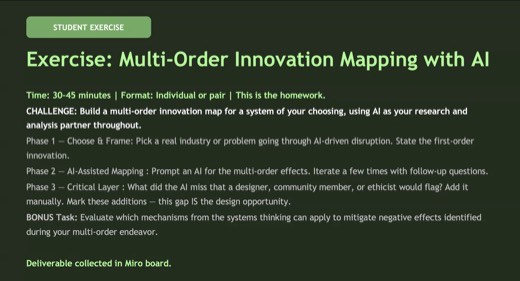
The homework, mapped
The close · 8:34 PM
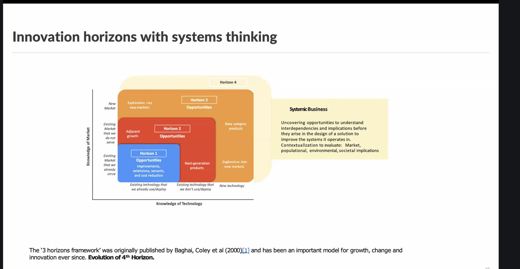
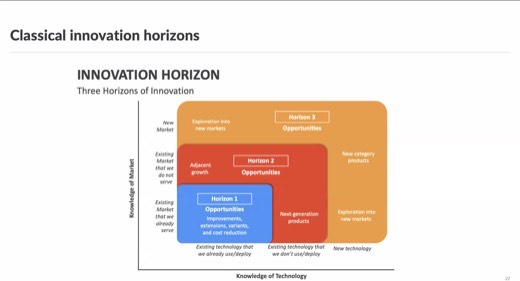
The three horizons of innovation and the fourth Katrin adds
- Horizon 1 is improvements to what already exists: variants, extensions, and cost reduction, on technology and markets already served.
- Horizon 2 is adjacent growth: a market not yet served, or technology not yet deployed, her example a gas vehicle moving to electric.
- Horizon 3 is genuinely new markets, products, and technology, her example a connected EV heading toward autonomous driving.
- Horizon 4 is Katrin's own addition: AI aimed at whole systemic problems at population scale, climate, cancer, the kind of question no single business unit owns.
The homework runs the same discipline on a real problem.
- Pick an industry or process actually going through AI-driven disruption.
- State its first-order innovation plainly.
- Use AI to map the effects out to the third, fourth, and fifth order, iterating past the first pass every time.
- By hand, mark what a designer, a community member, or an ethicist would add that the map missed, since that gap is the design opportunity.
Due the following Tuesday or Wednesday, solo or in pairs, on the highest-power model available.
Try this prompt
Quiz me on the four systems-thinking mechanisms and the innovation ladder's three tiers. Then give me a real industry change and make me map its multi-order effects, my prediction of what's missing first, before you check me.
You will know it worked whenit quizzes you on the four systems-thinking mechanisms and the ladder's three tiers first, then makes you map a real change's multi-order effects, your prediction first.
The shelf
Tools and references
Tools that night
- ChatGPT or Claude as a systems-thinking and multi-order-thinking partner
- Miro, where the multi-order innovation map homework is collected
- A high-power model recommended specifically for the homework
Named in the room
- Donella Meadows, "Leverage Points: Places to Intervene in a System," the canonical short version
- The EU AI Act, her balancing-loop example
- The Cannes Lions "Sato" case study (Japan) · the three-horizons framework, Baghai, Coley et al, 2000
Every frame from this class
23 captures, in order. Click any one to see it full size.